
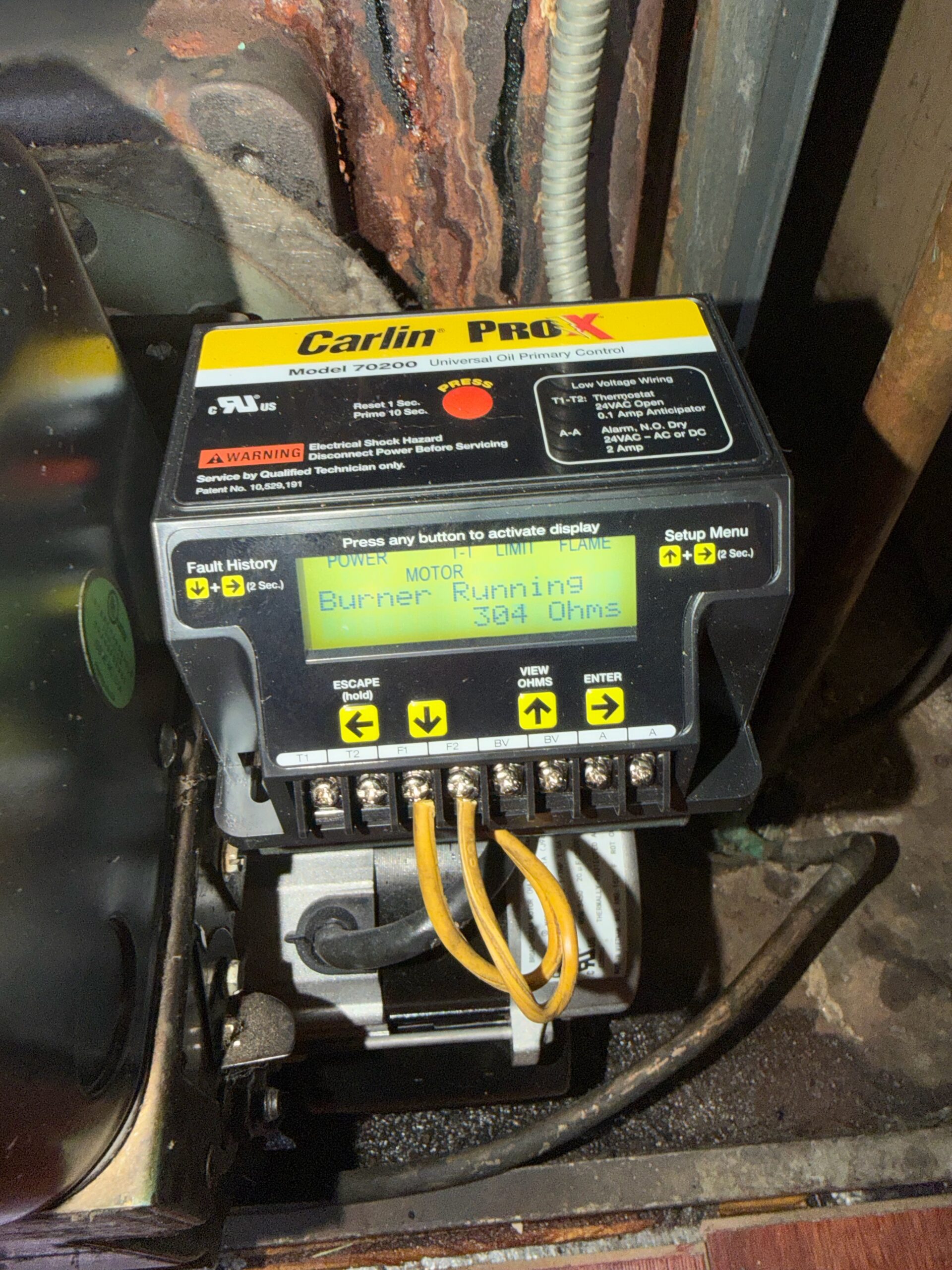
An oil burner goes into reset, also called “lockout,” when its safety control tries to light the burner and doesn’t see a steady flame. To keep unburned oil from building up, the control shuts the burner down and waits for someone to step in. If it happens once, the cause may be something simple, like running out of oil. If it keeps happening, something in the system needs a technician. The usual suspects are a clogged filter, a worn nozzle, a dirty flame sensor or a failing pump.
The most important takeaway: a lockout is a warning sign, and the reset button is not a fix. Here’s what the reset means, what usually causes it, what you can safely look at yourself, and when to stop and call.
What the reset button actually is
Every oil burner has a primary control, a small box mounted on or near the burner. Each time your thermostat calls for heat, the control runs a quick check. The motor starts, oil sprays through the nozzle, a spark lights it, and a sensor confirms there’s a flame.
If that sensor doesn’t confirm a flame within a few seconds, the control cuts power to the burner. That’s the lockout. The red button on the control tells it to try again. Don’t press it yourself. Leave that button to a technician, who can find out why the burner locked out before restarting it.
It’s a safety feature, and it works well. The trouble is that pressing the button doesn’t fix whatever caused the lockout. Each attempt can spray more oil into a combustion chamber that isn’t lighting properly. That oil can pool and vaporize, and then it can ignite all at once. Techs call this a puffback. It can blow soot through the house, damage the boiler or furnace, and in serious cases start a fire. Many newer controls limit how many times they can be reset for exactly this reason. Once they hit that limit, only a technician can clear them.
Rule of thumb: if your burner is in reset, don’t press the reset button. Check the simple things below, then call for service.
Why it happens more in the fall
Around Bristol, Levittown and Bensalem, the first chilly nights of fall bring a wave of lockout calls. That makes sense. The burner may have sat idle, or only made hot water, for months. Then it’s suddenly asked to run long cycles. Problems that were building quietly all summer show up: a filter loaded with sediment, a nozzle that’s partly clogged, a flame sensor with a film of soot on it. That’s a big reason an annual tune-up before heating season matters so much.
The most common causes of repeated lockouts
You don’t need to diagnose these yourself. Knowing them helps you describe the problem when you call and understand what the tech finds.
Low or no oil
The most common cause, and the easiest to rule out. Without oil, there’s no flame. Even with some oil in the tank, a low level can let the pump pull air or sludge.
Clogged oil filter
The filter catches sediment and water before they reach the burner. As it fills up, oil flow drops and the flame turns weak or unsteady. The control sees that as a failed start and locks out.
Worn or clogged nozzle
The nozzle turns oil into a fine, cone-shaped mist. A small blockage or a worn tip makes the spray uneven. The flame becomes hard to light and hard to hold. Nozzles are small parts, and swapping them is a normal part of a tune-up. Getting the right nozzle in place and setting it up properly is a job for a tech.
Dirty or failing flame sensor
Most oil burners use a light-sensitive “cad cell” to see the flame. If it’s covered in soot or is failing, the control can think there’s no flame even when there is one. It shuts the burner down anyway.
Ignition problems
The burner lights the oil with a high-voltage spark. Worn electrodes or a weak igniter can mean no spark or a weak one, so the burner never lights.
Fuel pump or air in the line
A pump that’s wearing out, a loose fitting, or air that got into the line after a run-out can all interrupt the oil supply. Sometimes you’ll hear a whine or a change in the burner’s sound before it locks out.
Draft and combustion air problems
A burner needs fresh air coming in and exhaust going out the chimney or vent properly. A blocked chimney, a bad draft, or a boiler room that’s been closed off and starved of air can all cause poor combustion and lockouts. These are safety issues. Exhaust that doesn’t vent correctly can carry carbon monoxide into the home.
What you can safely check
These checks are safe because none of them involve opening the burner, touching wiring, or handling oil:
- Your oil level. Look at the float gauge on top of the tank. If it’s near empty, order oil, and mention the lockout when you call.
- The thermostat. Confirm it’s set to heat and turned up. Replace its batteries if it uses them.
- The emergency switch. Make sure the burner’s service switch, often a switch with a red plate at the top of the basement stairs or near the boiler, hasn’t been flipped off by accident.
- The area around the boiler or furnace. Make sure nothing is stacked against it or blocking airflow to the room. Storage tends to creep in over the summer.
- Notes for the tech. Write down when it locked out, what you heard (rumbling, a whine, a bang), and whether you’ve noticed any odor. That information speeds up the repair.
That’s where homeowner checks end. If the oil level is fine and the switches are on, the next step is a phone call, not the reset button.
Signs you should stop and call right away
Call for service right away, and leave the reset button alone, if:
- It has locked out more than once
- You hear a rumble, boom or “whoomp” when it starts
- You see soot around the burner, the boiler door, or on the walls near the chimney pipe
- You see oil under or around the burner or tank
- You smell oil, smoke or exhaust in the house
If anyone feels dizzy, nauseous or headachy, or your carbon monoxide alarm goes off, get everyone out of the house and call 911 from outside. Don’t go back in to check the burner. Every home with oil heat should have working CO alarms near sleeping areas and on each level.
How C&L Fuel can help
C&L Fuel Inc. is a local, family-owned heating, fuel and HVAC company. We work on oil burners every heating season in Bristol, Levittown, Bensalem and other parts of our Bucks County service area.
- Oil heating repairs. Our technicians can track down why your burner keeps locking out and get it running safely again.
- Maintenance on oil boilers and furnaces. A tune-up is one of the best ways to prevent fall lockouts, because worn and dirty parts get dealt with before they cause trouble.
- Automatic delivery. Ask about it. It takes the guesswork out of watching the tank, so a low oil level is one less thing to remember.
Frequently asked questions
Can I press the reset button myself?
No. Don’t try to reset a burner that has locked out. The reset button restarts a burner that its safety control shut down for a reason, and each press can let unburned oil build up. Check the oil level, the thermostat and the service switch. If your oil burner goes into safety lockout, stop and contact C&L Fuel Inc. for professional troubleshooting. Many newer controls limit resets anyway.
My burner went into reset right after I ran out of oil. Is that related?
Almost certainly. Running dry usually puts air and sometimes sediment into the line, and the burner can’t light until that’s fixed. A technician typically needs to restart it after the delivery.
Is a burner that keeps locking out dangerous?
It can be. The lockout itself is a safety feature. But whatever is causing it, whether poor combustion, a draft problem or a fuel issue, can lead to soot, puffbacks or exhaust problems. Treat repeat lockouts as a reason to get it checked soon.
Will a tune-up stop my burner from going into reset?
It often prevents the most common causes, like a dirty filter, a worn nozzle or a sooty sensor. It can’t prevent every failure, but it’s one of the best ways to protect against lockouts.
Why did my burner start locking out in the fall when it was fine all summer?
In summer, many burners only run in short bursts for hot water, or not at all. Long heating cycles in the fall expose clogged filters, worn nozzles and dirty sensors that had been building up all along.
Burner stuck in reset?
Don’t press the reset button. When you call, tell us what you’re seeing and hearing, and mention it if your system hasn’t had its annual tune-up yet. Our regular office hours are Monday through Friday, 9 AM to 5 PM. Our phone is answered 24/7. If you’re experiencing a heating problem, call C&L Fuel Inc. at 215-785-6161 to discuss available service options.
